When we first started studying differential equations, we focused on one equation and one dependent variable. But the real world is rarely that simple. Populations of predators and prey change together, chemical reactions involve several substances interacting, and mechanical systems often involve multiple moving parts.
In this chapter, we’ll explore what happens when more than one quantity is changing at once and how we can describe that with systems of differential equations.
A system of differential equations is exactly what it sounds like: a collection of differential equations that must be solved together. Instead of tracking a single unknown function, we track several unknowns — and they may influence each other.
Here \(f\) and \(g\) describe how each quantity changes over time — possibly depending on the other quantity. This setup is common in science and engineering because many real-world situations involve several connected variables evolving at the same time.
Unlike single equations, systems can include interaction. One variable might depend on another — or they might depend on each other. This can produce richer behaviors like oscillations, balance points, or feedback loops. Solving systems sometimes calls for new tools, like matrix methods, but the ideas will still build on what you already know.
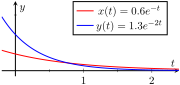
The uncoupled system is no more than two independent differential equations that you have solved before. Far more interesting are the coupled systems, where changes in one variable directly influence changes in the other.
These are called uncoupled because the \(x\)-equation has no \(y\) and the \(y\)-equation has no \(x\text{.}\) There’s no interaction — they’re basically two separate problems packaged together.
You might imagine \(x(t)\) describing a cup of coffee cooling while \(y(t)\) describes a soda warming up — two unrelated processes happening side by side.
Figure271.Solution trajectories in the phase plane for the uncoupled system \(x' = -x\text{,}\)\(y' = -2y\text{.}\) Arrows indicate the direction of motion as time increases.