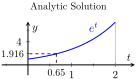
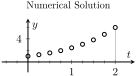
Most of what we’ve done, so far, has been focused on finding exact solutions to differential equations, like \(y(t) = e^{-3t} \sin(2t)\text{.}\) This kind of solution is called an analytic solution, or sometimes a closed-form solution. It is valuable because it expresses \(y(t)\) as a formula-like structure that you can plug in any value of \(t\) and instantly get the exact \(y\)-value.
simply don’t have a tidy closed-form solution. In those cases, we switch tools. Instead of searching for an exact formula, we use a numerical method. A numerical method doesn’t hand you \(y(t)\) as a formula—it builds an approximation, one step at a time, starting from what you know and using the differential equation to predict what happens next. The result is a numerical solution.
The analytic solution gives a smooth curve for every \(t\text{.}\) The numerical solution gives dots—a sequence of approximations. Connect those dots and you get a picture of the solution’s shape, even though no formula was found.
Numerical solutions are approximations. They carry small errors, but in exchange, they let us handle equations that analytic methods can’t touch. This trade-off between perfect precision and practical usefulness is at the heart of numerical methods.
At first glance, analytic solutions might seem “better” than numerical ones. But there are important reasons why numerical methods aren’t just useful—they’re essential:
Many equations simply don’t have a closed-form solution.